
On 7 January 2015 at about midday local time, I sat down to lunch with my colleagues in the 14th arrondissement of Paris.
It was then that I learnt how around 30 minutes earlier two brothers, Saïd and Chérif Kouachi, forced their way into the 11th arrondissement offices of the French satirical newspaper Charlie Hebdo.
We all know what followed.
Today marks the two-year anniversary of the deaths of Frédéric Boisseau, 42; Elsa Cayat, 54; Charb (Stéphane Charbonnier), 47; Franck Brinsolaro, 49; Bernard Maris, 68; Ahmed Merabet, 42; Mustapha Ourrad, 60; Cabu (Jean Cabut), 76; Tignous (Bernard Verlhac), 57; Georges Wolinski, 80; Philippe Honoré, 73; and Michel Renaud, 69.
Frédéric Boisseau was a building maintenance worker. Elsa Cayat was a psychoanalyst and columnist. Charb (Stéphane Charbonnier) was a cartoonist, columnist, and director of publication. Franck Brinsolaro was a Protection Service police officer assigned as a bodyguard for Charb. Bernard Maris was an economist, editor, and columnist. Ahmed Merabet was a police officer. Mustapha Ourrad was a copy editor. Cabu (Jean Cabut), Tignous (Bernard Verlhac), Georges Wolinski, and Philippe Honoré were cartoonists. Michel Renaud was a travel writer and festival organiser visiting Cabu.
This event is significant to us all. It is a loss of life.
7 January 2015 will always stay with me. Partly, because of the extensive media coverage and the debates that ensued, but mostly due to its proximity and the sense of personal vulnerability.
What I will always remember about this event is how lucky I am that at almost 23 years old this is the closest encounter I have had with acts of terror.
There have been many articles written, statuses posted, and tweets sent regarding the number of deaths of prominent celebrities in 2016, and while I am by no means belittling the significance of every single loss of human life, I cannot help but think how lucky we are.
What fortune we have that it is the names of much loved musicians making our headlines and not the merciless mass murdering of our own people under our very noses.
There is significance behind the naming of the victims of the Charlie Hebdo shooting. All too often deaths are reduced to numbers. 12 died on this day two years ago, but the number is not important.
Today we must remember the people behind the statistics.
Frédéric Boisseau was a building maintenance worker. Elsa Cayat was a psychoanalyst and columnist. Charb (Stéphane Charbonnier) was a cartoonist, columnist, and director of publication. Franck Brinsolaro was a Protection Service police officer assigned as a bodyguard for Charb. Bernard Maris was an economist, editor, and columnist. Ahmed Merabet was a police officer. Mustapha Ourrad was a copy editor. Cabu (Jean Cabut), Tignous (Bernard Verlhac), Georges Wolinski, and Philippe Honoré were cartoonists. Michel Renaud was a travel writer and festival organiser visiting Cabu.
Each person killed in terrorist attacks and civil wars are human too. Christians, Muslims, Hindus, Jews, Buddhists, and Atheists alike.
The Syrian Centre for Policy Research (SCPR) reported 470,000 fatalities caused by war, directly and indirectly, according to the Alienation and Violence Report 2014. In all, 11.5% of the country’s population have been killed or injured since March 2011, the report estimates.
This number is now three years out of date.
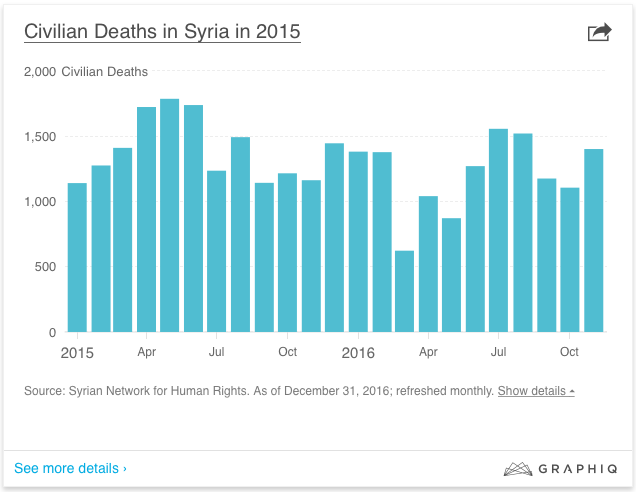
The onus lies not just with the media but with all of us as human beings to see the people and lives behind the statistics: the fathers, mothers, brothers, sisters, partners, friends.
Such lives lost diminish us all.
 Sophia C McBride
We must recognize that the suffering of one person or one nation is the suffering of humanity. Dalia Lama
LikeLike